



From Keywords to Conversations: How Conversational Search Is Becoming Your Best Digital Sales Associate
Just last year, buyers typed keywords.
Today, they expect search to understand intent, specs, and real-world buying needs instantly.
Before, this was a common search: 鈥渟teel pipe鈥�
But now, customers are used to asking questions in natural language: 鈥�3/4 inch stainless schedule 40 pipe, sold by the foot - what鈥檚 in stock and what鈥檚 the equivalent in mm?鈥�
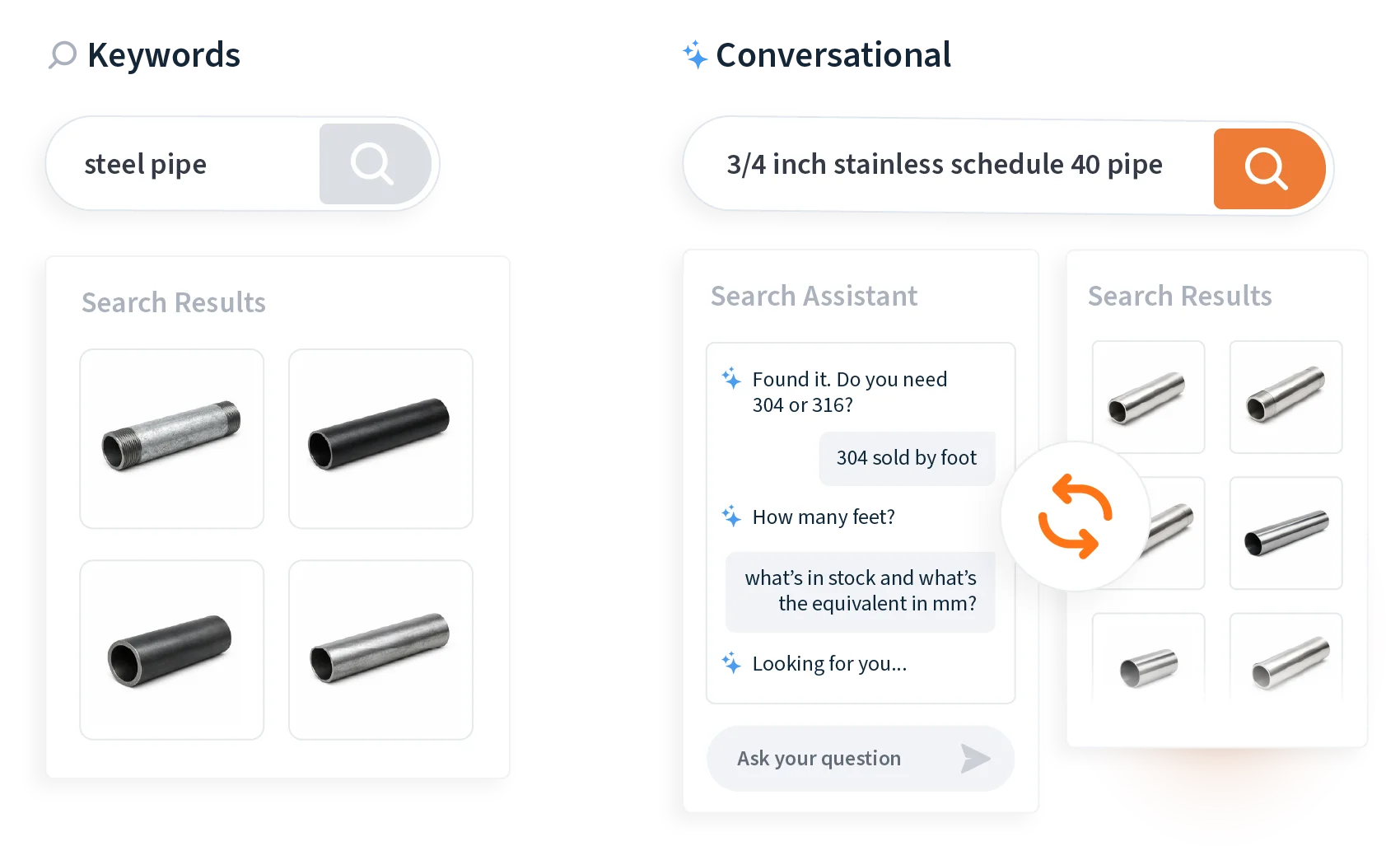
B2B catalogs aren鈥檛 simple. They鈥檙e full of:
- Complex attributes and specs
- Variants and compatibility
- Pricing/packaging rules
- Units of measure (and constant conversion headaches)
When search can鈥檛 keep up, your customers feel it fast:
- Customers can鈥檛 find the right product
- They call sales for things they should self-serve
- They leave your website for competitors' websites
AI agents in B2B eCommerce aren鈥檛 a nice-to-have anymore. They鈥檙e a practical response to how buyers shop now: with specific, complex needs and a low tolerance for friction.
If your search experience is still stuck in keywords, you鈥檙e forcing customers to do the hardest work themselves (interpretation, conversion, comparison, qualification). And when they can鈥檛, they escalate to sales or leave.
This article will walk you through what a modern search experience can be.
Why 鈥渟earch鈥� is becoming your best digital sales associate
If you sell into distribution and manufacturing, you already know the truth: your sales team isn鈥檛 鈥渙rder taking.鈥� They鈥檙e navigating pricing exceptions, negotiated deals, substitutions, fulfillment realities, credit terms, and relationship trust often at the same time. The PDF frames this clearly: sales excellence is part product knowledge, part responsiveness, and part problem-solving under real constraints.
That鈥檚 exactly why the next evolution in B2B eCommerce isn鈥檛 just 鈥渂etter search results.鈥� It鈥檚 agent-like search, a system that can shoulder repetitive, high-volume questions so your reps can focus on high-value selling.
The promise isn鈥檛 replacing human expertise. It鈥檚 packaging that expertise into the digital experience so customers get answers faster and your team gets leverage.
The search bar is the front door to help (whether you planned it or not)
Your website search bar is the most natural place customers go when they need help. It鈥檚 familiar behavior, high-intent, and already part of the buying workflow.
So when buyers land on your site with a complex request, part number in one hand, a spec sheet in the other, and a deadline looming, search becomes the first line of support.
That鈥檚 where AI agents show up: not as a separate chatbot that customers may ignore, but as an intelligence layer embedded into the discovery experience.
Go beyond keywords: the agentic experience buyers now expect
Modern B2B buyers don鈥檛 just want 鈥渞esults.鈥� They want guidance. Intelligent search shifts from keyword matching to conversational discovery and problem-solving, including:
- Answering complex product questions (including ambiguous queries where context matters)鈥�
- Refining searches and summarizing options so buyers don鈥檛 get zero results
- 鈥�Recommending next best steps when the 鈥渞ight answer鈥� depends on use case
- 鈥�Supporting multiple input (search) modes like images or barcode scanning for quick lookups
- 鈥�Personalizing responses at scale including pricing and inventory by location
- 鈥�Helping customers ask technical questions that require access to documentation like PDF spec sheets
- 鈥�Letting buyers upload order sheets (PDF/CSV) to accelerate purchasing
- 鈥�Integrating with other systems/agents so customers can move from 鈥渇inding鈥� to 鈥渄oing鈥� in one experience
Does this sound similar to your strongest sales rep on their best day - fast, informed, and helpful.
鈥�What this changes operationally (and why it matters to revenue)
When intelligent search takes on repetitive questions, status checks, basic quoting, routine requests, it helps you scale, without losing the human touch.
Operationally, that shows up as:
- Fewer 鈥渃all sales鈥� interruptions for basic discovery and spec lookups
- 鈥�Less back-and-forth on product clarification (because search can guide and narrow)
- 鈥�Higher conversion due to faster discovery and fewer dead ends
- 鈥�Better coverage without headcount, especially for after-hours and peak volume
And when you layer in B2B realities, pricing groups/entitlements and branch-level inventory, intelligent search becomes more than helpful. It becomes credible. Customers see what they can actually buy, at the price they鈥檙e entitled to, where they need it.
That credibility is what builds confidence to click 鈥淎dd to Cart鈥� instead of 鈥淐all my rep.鈥�
The underappreciated superpower: technical document understanding
In many B2B verticals, the truth is hidden in PDFs: spec sheets, compliance requirements, compatibility notes, installation details. Customers need answers buried in technical documents and intelligent search should let them ask questions directly rather than manually digging through PDFs.
- Faster technical research for customers
- Fewer emails and calls for spec confirmation
- More self-serve confidence for engineers, techs, and procurement
If your team spends time answering 鈥淒oes this meet X requirement?鈥� or 鈥淲hich gasket fits this flange?鈥濃�攄ocument-aware search is one of the most immediate ways to reduce friction.
The takeaway
When your search behaves like an always-available sales associate answering questions, guiding discovery, supporting specs, and accelerating ordering, you don鈥檛 just improve your customers experience. You scale selling.
色色研究所 is purpose-built for complex B2B catalogs and is recognized as a top B2B search solution (including 鈥淏est B2B Search鈥� according to Gartner).
Book a demo and鈥痺e鈥檒l鈥痺alk through鈥芯克�痷sing real B2B catalog scenarios including unit conversions and complex spec filtering and share鈥痳esults our customers are seeing.

FAQs

